
By Carmen Curtis, Founder of AIReal Yoga®
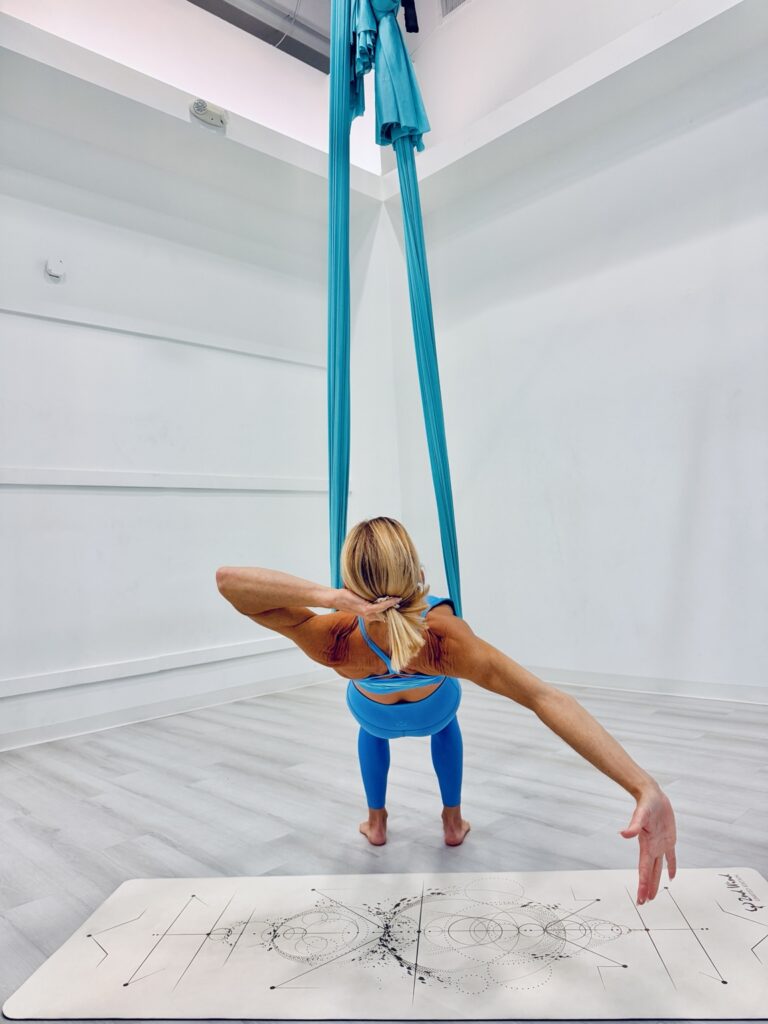
Our shoulders are capable of an incredible amount of movement. We reach, push, pull, rotate, carry weight and support ourselves through our arms—often without thinking about everything happening inside the shoulder joint.
But mobility alone does not create a healthy shoulder. The shoulder also needs strength, stability, coordination and awareness.
That balance is the focus of Strong & Spacious Shoulders, a new class in the AIReal Yoga® on-demand class catalog. Using the aerial hammock as a supportive prop, we explore how to build shoulder strength and mobility while recognizing some of the subtle compensations that can pull us out of alignment.
Can You Feel What Your Shoulders Are Doing?
Many people do not recognize when their shoulders have moved out of a supportive position. The body is remarkably resourceful: when we want to reach farther, hold ourselves up or create a deeper-looking pose, it will often find another way to accomplish the task.
You might:
- Pull a shoulder forward to extend your reach
- Lift the shoulders toward the ears when a movement becomes challenging
- Grip through the neck and upper trapezius
- Lock or hyperextend the elbows and sink into the joints
- Flare the ribs or change the shape of the spine to create more apparent shoulder mobility
- Move the shoulders every time you turn or tilt the head
These patterns are not failures, and they are not something to judge. They are information. They may show us where we need greater strength, mobility, proprioception or control.
The first step is simply learning to notice them.
Strong Shoulders Are Not Rigid Shoulders
When people hear “proper shoulder alignment,” they may imagine pulling the shoulders down and back and holding them there throughout every movement. But the shoulder blades are meant to move. They glide, rotate, widen and draw toward one another as the arms and spine change position.
The goal is not to freeze the shoulders in one supposedly perfect shape. The goal is to develop enough awareness and active support to distinguish intentional movement from unconscious compensation.
In one position, the shoulder blades may draw gently toward one another to support the upper back and open the chest. In another, such as Downward-Facing Dog, they need to rotate and move in a way that supports the arms overhead. Alignment is not one static instruction applied to every pose. It is an adaptable relationship among the hands, elbows, upper-arm bones, shoulder blades, ribs, spine and breath.
Strong shoulders can support movement without gripping. Spacious shoulders can move freely without passively sinking into the joints. We need both.
Why Foundational Poses Reveal So Much
Familiar poses such as Plank, Table and Downward-Facing Dog can tell us a great deal about our movement patterns.
In Plank, do you actively press the floor away, or does the chest sink between the shoulders? Do the shoulders roll forward as the pose becomes tiring? Are the elbows actively supported, or are you resting at the end range of the joint?
In Downward-Facing Dog, are you creating length through the spine and arms, or pushing the chest toward the floor to make the pose appear deeper? Does the neck remain spacious, or do the shoulders creep toward the ears?
These poses may be foundational, but foundational does not mean simplistic. When we slow them down, they become powerful opportunities to study how we organize the body under load.
What the Hammock Can Teach Us
The aerial hammock is more than something that holds us in the air. In AIReal Yoga®, it acts as a prop that can support, challenge and provide feedback.
The hammock may partially unload a position so we can explore shoulder mobility with less pressure. It can also add resistance, requiring us to actively press, pull and stabilize. Because the fabric responds to our movement, it often makes our habits easier to feel. We may suddenly notice that one shoulder lifts, one elbow locks or the ribs shift as we reach.
Throughout Strong & Spacious Shoulders, we use the hammock to explore:
- Wrist, arm and shoulder mobility
- Pulling strength with attention to the lats and upper back
- Shoulder stability in Table, Plank and Downward-Facing Dog variations
- Controlled spinal movement without allowing the neck and shoulders to take over
- Shoulder rotation and supported stretching
- The relationship between strength and flexibility
- How alignment changes when we add balance, suspension or a longer lever
The purpose is not to create the largest movement. It is to understand where the movement is coming from and whether we can support it.
For Students: Curiosity Before Correction
As you practice, try not to approach alignment as a list of positions you must perform perfectly. Instead, become curious.
Ask yourself:
- Can I soften unnecessary tension without losing support?
- What happens to my shoulders when the movement becomes more difficult?
- Can I move my head or spine without automatically moving my shoulders?
- Am I using muscular support, or am I hanging in my joints?
- Can I reduce the range and create more control?
- Can strength help me experience more freedom rather than more tension?
Sometimes a smaller, better-supported movement gives us more useful information than reaching the deepest possible position. Movement quality matters more than movement quantity.
For Teachers: Look Beyond the Final Shape
When teaching shoulder alignment, it is easy to focus on the visual endpoint: Are the arms straight? Are they beside the ears? Does the pose resemble the version we expected?
But a shape does not tell us how the student arrived there or where the force is being absorbed.
Look at the whole movement chain. What are the hands and wrists doing? Are the elbows actively supported? How are the upper arms relating to the shoulder sockets? What are the shoulder blades, ribs and spine doing? Is the student breathing, or are they gripping and holding their breath to maintain the position?
Avoid forcing every student into an identical shoulder position. Anatomy, mobility, strength, injury history and proprioception differ. A useful cue helps the student create more support, space or understanding; it should not simply make the pose look more aesthetically precise.
Rather than repeatedly saying “shoulders down,” consider what the movement actually requires. You might cue students to:
- Press into the foundation and lift out of the joints
- Create space through the neck
- Engage the lats or side body before pulling
- Widen across the upper back
- Keep the ribs organized as the arms move
- Reduce the range until the movement can be controlled
- Notice where the movement begins and what else moves with it
The goal is not to correct a body from the outside. It is to help the student develop enough awareness to understand and organize the movement from within.
Strength Supporting Flexibility
Flexibility without active support can become passive sinking. Strength without mobility can become gripping and rigidity. Sustainable movement asks us to develop both.
That is why this class moves between pulling, pressing, weight-bearing, rotation, supported stretching and rest. Students have opportunities to strengthen the shoulders, explore range of motion, notice compensation and then integrate the work in Floating Savasana.
The practice is a reminder that alignment is not about creating a perfect pose. It is about building a relationship with the body—one in which we can recognize when to stabilize, when to move and how to create both strength and space.
Strong & Spacious Shoulders is now available in the AIReal Yoga® on-demand class catalog. Join Carmen Curtis for this alignment-focused practice and explore how the aerial hammock can help you build stronger, more mobile and more aware shoulders.
Practice Strong & Spacious Shoulders with Carmen
Already subscribed? Sign in to your class library and search for Strong & Spacious Shoulders. The full class includes its printable teacher lesson plan and class discussion.
New to AIReal Yoga®? Try a free class to experience Carmen’s teaching.
Enjoyed this?
Receive Carmen’s newest blog posts by email.