
By Carmen Curtis, founder of AIReal Yoga®
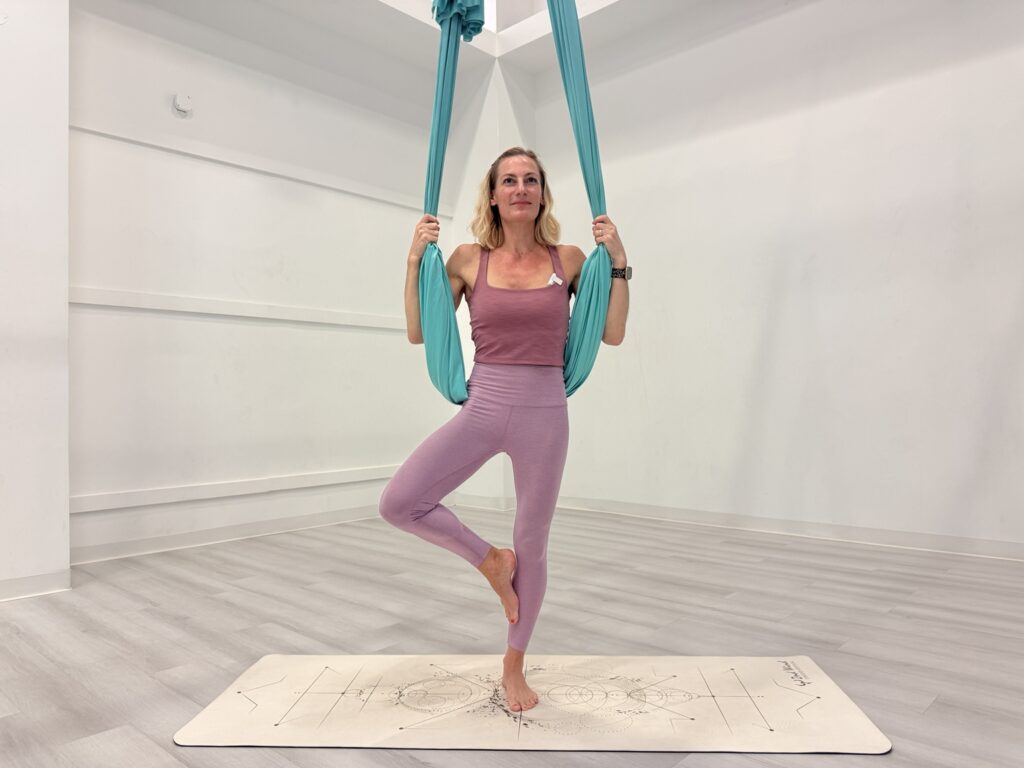
When we think about balance, we often picture the finished pose: one foot on the floor, the other lifted, and a moment of stillness. But I want to bring your attention to what happens just before that moment—and what happens when you come out of it.
Where does your weight go before your foot lifts? Do you give yourself time to arrive on the standing leg? Can you place the foot down with the same attention you used to lift it?
These small transitions are part of the practice. They also connect our yoga to the way we move through everyday life.
Notice the moment before the movement
Before one foot leaves the floor, something has to change. Your weight shifts. One leg takes on more of the work. You may reach for support, grip a little harder, or hurry through the part that feels uncertain.
In my teaching, I like to slow that moment down. We can explore the weight shift while both feet are still touching the floor. There is no need to rush toward a bigger shape. Sometimes noticing how you prepare tells you more than holding the pose for another few breaths.
The question I want you to explore is: How am I supporting myself right now?
The entrance and exit belong to the pose
It is easy to give all our attention to arriving in a posture and then let that attention disappear as soon as we are ready to leave. I want us to stay curious through the whole movement.
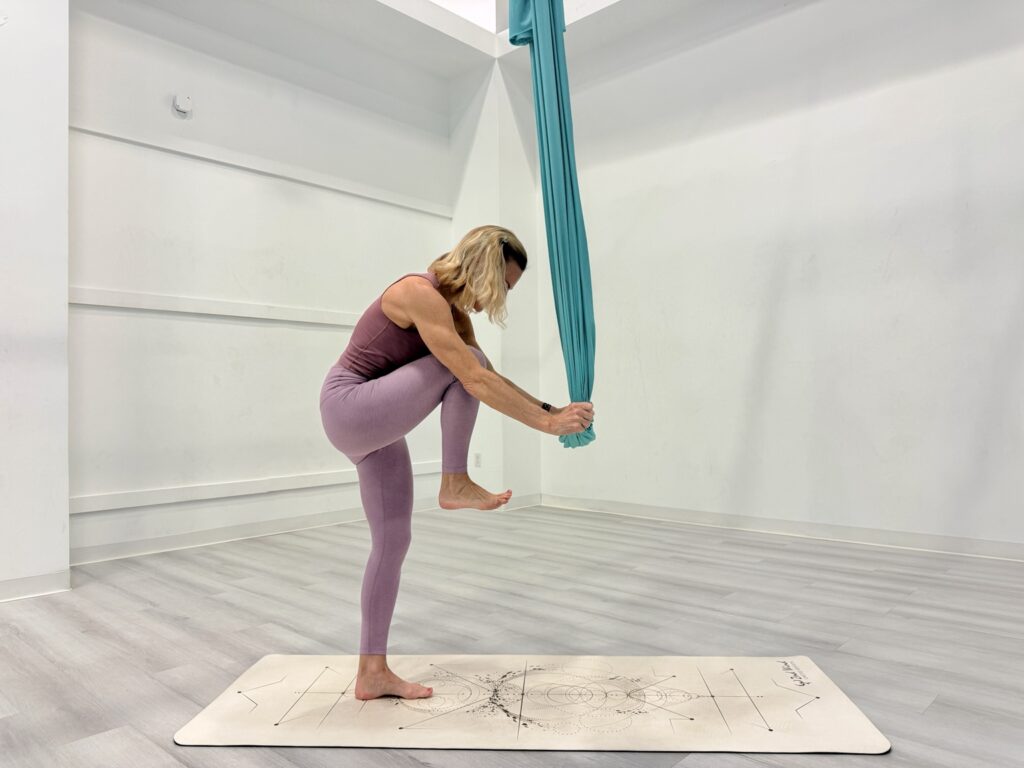
Bringing a foot into the hammock, for example, includes several moments: shifting your weight, lifting the knee, finding the fabric, and settling into the position. Coming out deserves that same care. If you feel rushed or crowded, pause and adjust your setup. Lower the hammock to meet your body instead of forcing your body to reach it.
A direct entrance may feel familiar to an experienced practitioner. Someone learning the movement may benefit from breaking it into smaller steps. I want the transition to suit the person practicing, with enough support and time to understand what is happening.
Let support give you information
In AIReal Yoga, I use the hammock as a prop. During standing balance, contact with the fabric gives us another place to notice how we are moving. Are you gripping tightly? Pulling yourself toward the hammock? Can you feel the work through the foot and leg that are supporting you?
One question I like to offer is: How lightly can you hold the hammock and still feel steady? That is an exploration, not a requirement to let go. Some days more support is the right choice. The amount of support can change during the practice, too.
With the hammock suspended from a single point, its support can move with you. I invite you to stay awake and alive inside that support, noticing the small adjustments through your feet, legs, and center as you find your balance. The muscles that help stabilize you still have a role to play. Let the hammock give you enough support to explore those adjustments with attention and ease. We can change its height, our grip, and the size of the movement to meet what we need that day.
Balance for the life you want to keep living
Stepping over a threshold, turning to reach for something, getting out of a chair, and walking around an obstacle all ask us to organize our bodies as we move. This is what I mean when I talk about functional movement: paying attention to abilities we use beyond the mat.
When I think about longevity, I think about continuing to participate in the things that matter to us. I want my practice to make room for strength, movement, curiosity, and the freedom to adapt as my body changes.
Balance belongs alongside cardiovascular activity and muscle strengthening as we age. One of the beautiful things about AIReal Yoga is that we can explore all three within our practice. We can challenge our muscles through active holds and controlled movement, give balance our attention, and use sustained, more active flows for cardiovascular work when they raise our breathing and heart rate enough. I encourage you to look across your week: are you making room for all three? Choose classes with different intentions, at a level that meets your body today.
Bring this attention into your next practice
Choose one familiar transition and give it a little more attention. Notice the preparation, the movement itself, and the return. Use the support you need, and make the movement smaller if that allows you to stay comfortable and steady.
If you teach, try this for yourself first. Then consider giving your students time to explore the entrance and exit, as well as the pose. A pause can be useful teaching space.
Afterward, ask yourself: Where did I rush? Where did support help me notice more? What changed when I gave myself time?
You do not have to turn every movement into a test. Let it be a conversation with your body.
Practice with me
In Standing Balance with the Hammock, we explore these ideas through approximately 25 minutes of practice. Members can find the class in Short Flows in the AIReal Yoga® on-demand membership. The downloadable class discussion and pose-by-pose lesson plan are there to save, print, and revisit for your own practice or teaching.
Already a member? Open Standing Balance with the Hammock and find the printable discussion and lesson plan beneath the video.
Enjoyed this?
Receive Carmen’s newest blog posts by email.